Friday, October 17, 2014

#1 Responsibility/Dollars and Sense


Core Value: Responsibility
Theme: Dollars and Sense

October Pack Meeting Plans: “Responsibility” AND “Dollars and Sense


Gathering Activity
How Much Does It Cost


Have participants work in teams (or as individuals). Cut out pictures of different items of interest to Cub Scouts, and have these mounted around the room. Using your greatest diligence (searching high and low) try to come up with real, advertised best prices for those items. Ask the teams to guesstimate the price of each item, and then compare their guesses to the prices you found. Winner is the guess that comes closest without going over the correct price.


Alternate: Post several prices below each picture and ask people to choose the correct price.


Opening Flag Ceremony
Freedom


Personnel: Cub Scouts enter, each holding posters with pictures of the United States flag on front and their lines on the back in large print. The narrator (Cubmaster or den leader) begins:


CM (DL): This month’s theme deals with dollars and sense, and the price we have to pay for things. In our country, we are privileged to experience the joy of freedom. But let us always remember that this privilege was not gained without a cost.

Cub #1: Stand up for the flag of America, wherever you may be.

Cub #2: Respect it and protect it, for it shall keep you free.

Cub #3: Free to do what you want to do, and say what you want to say.

Cub #4: Free to go where you want to go, and pray the way you want to pray.

Cub #5: Stand up for the flag of America, for all the world to see.

Cub #6: Stand up for the flag, that star-spangled flag, that stands for you and me.

ALL (or CM/DL): And now stand and all together say the Pledge of Allegiance.


Training Topic 


“Bobcat Badge” (begins on p. 48):


Audience Participation Activity
Skit:
The Trade


Materials: 5 different toys (e.g., small boat, small truck, small teddy bear, small book, ball).

Personnel: 5 participants and a den chief. When the scene opens, each participant is playing with a toy.

Den chief: Long ago, before there was any money, everyone traded or bartered the things they didn’t need for the things they wanted.

Boy #1 (with boat): Hey, want to trade me for that truck?

Boy #2 (with truck): No way! But I might trade for a book.

Boy #1 goes to find #3, who has a book.

Boy #1: Hey, want to trade that book for a boat?

Boy #3 (with book): No way! But I might trade for a bear.

Boy #1 goes to find #4, who has a bear.

Boy #1: Hey, want to trade that bear for a boat?

Boy #4 (with bear): No way! But I might trade for a ball.

Boy #1 goes to find #5, who has a ball.

Boy #1: Hey, want to trade that ball for a boat?

Boy #5 (with ball): Sure! I always wanted a boat.

Boy #1 leaves the boat, takes the ball, and returns to #4.

Boy #1 (now with ball): Hey, want to trade that bear for a ball?

Boy #4 (with bear): Sure! I always wanted a ball.

Boy #1 leaves the ball, takes the bear, and returns to Boy #3.

Boy #1 (now with bear): Hey, want to trade that book for a bear?

Boy #3 (with book): Sure! I always wanted a bear.

Boy #1 leaves the bear, takes the book, and returns to Boy #2.

Boy #1 (now with book): Hey, I’ve got a book. Want to trade for the truck?

Boy #2 (with truck): No, but have you got a boat?

Boy #1 runs off, screaming for his boat.


Cheers


Nickel’s Worth: Flip your thumb as though flipping a coin, and then catch it and slap it on the back of your hand. Then yell “Heads, a winner!”

Flip a Coin: If it’s heads everyone cheers. If it’s tails everyone claps.

Dollar Bill: Toss a dollar bill into the air. The audience claps while it is falling. Vary how long it takes to fall by catching it midair at different stages.

Heads and Tails: Divide the audience into two groups. One yells “Heads.”The other yells “Tails.” Point to one group and then the other, varying the speed until both groups are shouting in unison.

How to Clean Pennies


Edible Campfires:


Monday, October 13, 2014

#2 Citizenship/Give Goodwill & Respect/Stars and Stipes


November's Core Value: Citizenship
November's Theme: Give Goodwill
December's Core Value: Respect
December's Theme: Stars and Stripes

November Pack Meeting Plans:Citizenship” AND “Give Goodwill

December Pack Meeting Plans: Respect” AND “Stars and Stripes


Gathering Activtity
Five-Pointed Stars in One Snip


Materials: 8½” x 10” (not 11”) pieces of paper; scissors.

Background: George Washington’s original pencil sketch for our country’s flag indicated six-pointed stars, a form he apparently preferred. Betsy Ross, however, recommended a five-pointed star. When the committee protested that it was too difficult to make, she took a piece of paper, folded it deftly, and with a single snip of her scissors, produced a symmetrical five-pointed star. This seeming feat of magic so impressed her audience that they readily agreed to her suggestion.


To you, we pass along the secret: Take a piece of paper, 8½” x 10” (or an exact multiple), fold it as indicated, and cut a perfect five-pointed star. For more detailed instructions, visit http://www.ushistory.org/betsy/flagstar.html.


Step #1: Fold the paper vertically and horizontally into 4-inch squares as shown.

Step #2: Fold corner A and crease.

Step #3: Fold corner B to touch corner A, and crease.

Step #4: Fold corner C over the other folds, and crease.

Step #5: With scissors, snip across the folds on dotted line, as shown.

Step #6: Unfold the small triangle, and you have a five-pointed star.


Opening Flag Ceremony
It’s Just a Piece of Cloth


Post a United States flag in the front of the room. Dim the lights and place a spotlight on the flag. If possible, have a fan blowing on it, causing it to flutter. Then ask one or several Cub Scouts to solemnly read aloud the following poem:


It’s just a piece of cloth, that’s all it is.

Just a piece of cloth.

But when a little breeze comes along, it stirs and comes to life.

It flutters and snaps in the wind, all red and white and blue.

Then you realize that no other piece of cloth could be like it.

It has your whole life wrapped up in it …

The meals you eat, the time you spend with your family.

The things you learn at school.

The strange and wonderful thoughts you get at church.

Those stars on it: They make you feel just as free as the stars in the wide, deep night.

And the stripes; they are the bars of blood to any dictator that would try to change this way of life.

Just a piece of cloth, that’s all it is.

Until you put your soul into it, and give it meaning.

Then it is the symbol of liberty and decency and fair dealing for everyone.

It is just a piece of cloth, until we breathe life into it.

Until we make it stand for everything we believe in, and refuse to live without it.


Training Topic
“Community Service” (begins on p. 34):


http://www.scouting.org/filestore/training/pdf/511-410_wb.pdf

Opening Flag Ceremony #2
Prisoner of War Flag Ceremony


Equipment: American flag mounted to a blanket

Personnel: Two Scouts to hold flag, and a reader


READER: On a summer day in a prison camp during World War II, the prisoners were just completing a talent show when, without any announcement, two soldiers stood up in front of the group holding a rolled-up blanket. They looked quickly but carefully in all directions to make sure no guards were watching. Then, holding the blanket high, they let it unroll. Fastened to the inside of the blanket was the beautiful Stars and Stripes of the flag of the United States. (Scouts match their actions to the story.)


At the time of their surrender, one of the soldiers had taken down the flag and somehow managed to wrap it around his body. Covered by his uniform, it had not been discovered during the inspection of his personal belongings. He had been able to keep it hidden until he had arrived at the prison camp. As the blanket was unrolled, the other prisoners saw the flag. A ripple of wonder and amazement ran through the group, followed by a deep silence that comes only when the heart is too full to permit words to be spoken. With their eyes still gazing upon this beautiful banner, the soldiers rose to their feet and began to sing softly, but with pride. They sang our national anthem. Will the audience please rise, salute our flag, and join in singing our national anthem.


Cheers


Do a Good Turn #1: Everyone stand up, turn around, and sit back down.

Do a Good Turn #2: Have the group stand up to applaud. They clap once, and then make a quarter turn and clap again. They repeat this three times in the same direction, so everyone comes full circle.

Fireworks: Make a fist and raise it up in front of you and over your head.  Then open your fist and let your fingers flutter as your hand goes downward and you say, “ooooh, ahhhh.”

Constitution: “We the People, approve!”


Liberty Bell: Divide the group into two parts: the Dings and the Dongs. Alternate yelling “Ding---Dong---Ding---Dong---Ding---Dong!” Then all yell, “Let Freedom Ring!”

Firework  Neckerchief Slide


Materials: 18 inches of doorbell wire (or other wire that has multiple wires inside—the more colors inside, the better). **I used sprinkler wire.


Strip the wire apart so you now have a bunch of individual strands. Tie a square knot in the middle around either a dowel or a broomstick. Then curl the wires, using a pencil.


 Remember to come to the District Awards Night instead of Roundtable on December 4th. The attendance bead will be this clear one:


Thursday, August 14, 2014

Cooperation/Under the Big Top

Core Value: Cooperation
Theme: Under the Big Top

September Pack Meeting Plans:Cooperation” AND “Under the Big Top

Gathering Activity
Circus Photo Booth


Opening Ceremony
Under the Big Top


Personnel:
 10 Cub Scouts in circus costumes. (Or if you are short on boys, use 5 and double the parts.)

Materials:
Cards with circus pictures facing the audience. Parts are written on the back in large print.

Cub #1:
Under the Big Top is the theme for tonight. We love circuses and think it is a dilly;

Cub #2:
Both circuses and little boys can sometimes be quite silly.

Cub #3:
Den leaders find it a natural to do this kind of show.

Cub #4:
They run a three-ring circus every single week, you know.

Cub #5:
At a circus there is shouting, roaring, stamping, whistles tooting;

Cub #6:
Tumbling, pushing, falling, wrestling, and a rolling and a-rooting.

Cub #7:
At den meetings things keep moving, constant motion, constant noise.

Cub #8:
There are lots of things in common between circuses and boys.

Cub #9:
We’ve put all the dens together; it’s not Ringling Brothers, you know.

Cub #10:
But we think you will enjoy it, so let's get on with the show.

Training Topic
Join Scouting Night” (begins on p. 45):


Circus Ideas For Handing Out Awards


1) Put slips of paper telling which award the Scout is getting inside blown up balloons and have them throw darts to pop the balloons.
2) Have the boys walk a pretend tightrope holding an umbrella. If they make it to the other side they receive their award.
3) Make a cardboard cutout of a lion’s mouth. They boys receive their awards if they are brave enough to put their heads in the lion’s mouth.
4) Have the boys wear a clown costume and ride a mini-bike through an obstacle course to receive an award.
5) Attach awards to the inside of a blow-out noisemaker and when the boys blow the paper to unroll it they will see the award.
6) Have the boys perform a feat of strength by lifting a “heavy” barbell to receive their award.

Cooperation Run-Ons


All during the meeting, boys suddenly appear and demonstrate working together to do something – choose activities that require more than one person – in other words cooperation.  Here are some possibilities:
1)  Folding a Flag – one boy comes out, tries to fold the flag, then says, “Hey I need another set of hands”   Another boy or boys appears, and together, they get the job done.
2)  Playing catch – one boy comes out, says “Wish I had someone to play catch with!”  Another boy joins him, and they toss the ball back and forth a couple of times.
3)  A boy comes out with a big stack of newspapers, which he drops so they scatter all over the floor.  “Oh, no – look at this mess.  Wish I had some help!”  Another boy or boys appear and they get the papers stacked in no time and leave.
4)  A boy comes out with a paint can and a paint brush – he pretends to look at a very LONG fence.  “I’ll never get this fence painted in time to play ball” he says,  “Wish I had some help!”  Out comes another boy or even several boys with a brush – together they make motions of painting the whole length of the fence.
After each run on, either the boy or a Leader says, “Great. Now that’s what I call Cooperation!”

Cheers


Ferris Wheel (Swing your arm in a large circle. When you go up, everyone says “oooh!” and when you go down, everyone says “ahhh!”)

Strongman (Pretend to lift a barbell, straining with all your might. Grunt “ah, ah, ahhh” as you lift and “THUD” when you drop the barbell to the floor.)

Elephant (Everyone makes a trunk with their arms and makes elephant trumpeting noises.)

Heart & Sole (For someone who gives their heart and “sole” to Scouting. Everyone puts their hand over their heart and then touches one hand to one of the soles of their feet.)


Thursday, June 5, 2014

Honesty/Heroes of History

Core Value: Honesty
Theme: Heroes of History

August Pack Meeting Plans:
Honesty” AND “Heroes of History


GatheringActivity
My Story Mystery Game

The My Story Mystery Game is a great way to get to know some “history” about a group of individuals. It makes a great icebreaker. It can also serve as an introduction to a discussion about oral history and storytelling.

Materials
• Small slips of paper or index cards (one per player)
• Pencils (one per player)
• Container
 Instructions
1. Give each player a pencil and a piece of paper.
2. Have them write a few sentences about something which actually happened to them. Explain
that the others will have to guess who wrote it, so they should not use their name or write
something the others already know about in the story.
3. They must also write their name on the paper, so the leader will know whose story it is.
4. Put all of the stories in the container and mix.
5. The leader selects three of the stories from the container and those three people go to the front
of the group.
6. The leader tells the three stories which were selected.
7. The members of the audience get together and try to decide which story belongs to which
person.
8. Select three more stories and play the game again. Make sure each Scout gets at least one turn
to be one of the three people standing in front.

Opening Ceremony
Trailblazers

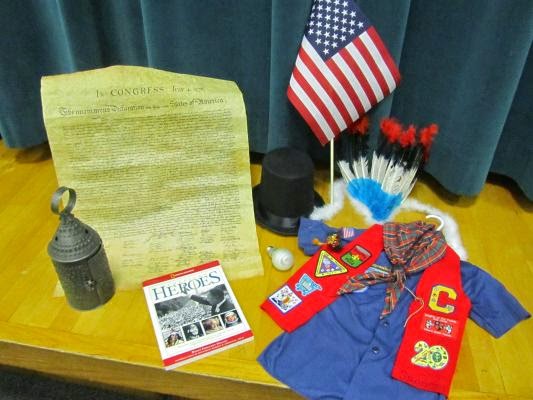
Preparation: Find the prop for each person and write what they are going to say on a card.


Narrator (opening a history book to read): Come join me now for just a minute while we look for heroes in history in my book. There are many heroes on these pages with tales of deeds through the ages.

Thomas Jefferson ( three-cornered hat or Declaration of Independence): I am Thomas Jefferson. The Declaration of Independence I did write, helping our country in its freedom fight.

Squanto (Indian headdress): I am Squanto. I helped the Pilgrims to stay alive that first winter in their
struggle to survive.

Neil Armstrong (astronaut helmet or hand-held flag): I am Neil Armstrong. I helped to blaze the trail into space for our land, and I was the first person on the moon to stand.

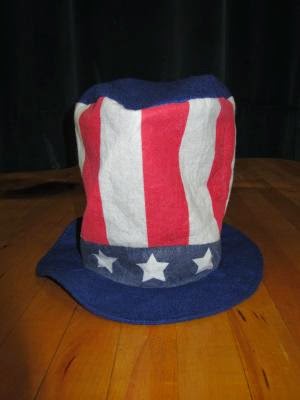
Abe Lincoln (stovepipe hat): I am Abraham Lincoln. As president, my best to the country I gave, and
helped to end the War Between the States.

Thomas Edison (lightbulb): I am Thomas Edison. I did my best to help my land without wait; the electric light I did create.

Paul Revere (lantern): I am Paul Revere. I made a famous ride to every farm to warn of the British and spread the alarm.

Cub Scout (in uniform): All these men who blazed a trail did their best and did it well. We are the future trailblazers of this land. You can bet we'll do our best to do our job grand!

Training Topic
Safe Scouting: The Rules That Keep Your Scouts Safe

Discussion leader should show the Guide to Safe Scouting, No. 34416C, to the Cub Scout leaders.
• Ask who in the class is familiar with the guide and its contents.
• Select several Cub Scout activities and discuss with the class how the guide addresses the safety issues of these activities.
• Discuss why Scouting places such emphasis on safety.
• We, as leaders, should model safe behaviors.
• Review the reporting procedures in the event of an accident.
• Discuss the BSA Annual Medical Form. The use of this form can help to assure that the boys are
healthy enough to participate in Scouting activities.
• Review the age-appropriate guidelines.
• Review two-deep leadership requirements.
• Youth protection begins with “You”!
• Adult leaders must repeat the course every two years.
Resources:
• Guide to Safe Scouting, No. 34416C
• Safety Thoughts—scouting.org
• Youth Protection training—www.scouting.org/Training/YouthProtection.aspx

Audience Participation Song
“American Legends”

Tune: “Davy Crockett”

Born on a mountaintop in Tennessee,
Greenest state in the land of the free.
Raised in the woods where he knew every tree
Killed him a bear, when he was only three
Davy, Davy Crockett,
King of the wild frontier.

Walked across the country with a sack on his back,
Saved Ohio settlers from Indian attack.
Shared all he had with anyone who lacked,
Apple trees now mark the path where he walked.
Johnny, Johnny Appleseed,
King of the farming man.

Made his living laying railroad rails,
The strongest man who could hammer those nails,
Then he was challenged to the race of his life,
Outworked a steam drill, but didn’t live through the night.
Big John, Big John Henry,
King of the railroad man.

Raised by coyotes and schooled by a bear,
His horse was a Widowmaker to those who dared,
Roped every varmint that flew through the sky,
Even a cyclone ‘cross the prairie he’d ride.
Pecos, Pecos Bill
King of the wild, wild west.

Commissioner’s Minute
Real Strength

America’s history is dotted with famous people—men and women and even children. We gain
inspiration from their stories. America’s strength has always been in her people. It took character to
survive that first winter in Plymouth, and another bad winter at Valley Forge. It took character to put
belongings into a rickety old wagon and push off into a land of vague promise. It took character to
tell a nation that slavery was wrong. Because character is needed today more than ever before, the
Boy Scouts of America is concerned about building strong character in boys. The BSA wants to help
guarantee that America is as strong in the future as it was at its birth. Our heroes in history show us
examples of great character. Cub Scouts can be the heroes of tomorrow as they learn about and develop that same character.

Cheers

Henry Ford cheer: Stand, pretend you are turning the crank on a Model T car (make chugging noises), then let out a big engine “ROAR” and sit down. Take the steering wheel and drive, blowing the horn with one hand and saying, “Aah-oo-gah!”
Paul Bunyan cheer: Divide the audience into two groups, the Chips and the Chops. As you point to each group, they yell in unison either “Chip!” or “Chop!” Repeat faster and faster until the tree is chopped down, then all holler, “Timber!”
Casey Jones Railroad cheer: CHOO, CHOO, CHOO, CHOO, CHOO, CHOO! WHOOOO! WHOOOO!
Grand Salute cheer: Slap your knees five times and count, “1-2-3-4-5,” then stamp your feet five
times as you count, then stand up and salute.


Closing Ceremony
Johnny Appleseed

Materials: An apple for each family or each Cub Scout or everybody. Your choice!
Johnny Appleseed was a pioneer hero, one of the very best. He didn't look much like one.
He was small and not very strong. He wore a tin pot for a hat and a coffee sack for a coat. Under his arm he carried a Bible and over his shoulder, a bag of apple seeds.
He had no knife. He had no gun. But he walked through sunshine and walked through rain--over the mountains, over the plains, and through forest trails knee-deep in mire looking for places to plant apple seeds.
While he was working, he thanked the Lord for giving him "the sun, the rain, and the apple seed." As legend goes, God was so pleased with Johnny Appleseed's selfless service that He put in the middle of every apple a star.
As we close our meeting, I will give each person an apple and ask that when you get home you slice the apple in half (demonstrate this) as I just did. You will see the star given to Johnny and to you for being part of our pack.


Monday, May 12, 2014

Courage/Space-the New Frontier

Core Value: Courage
Theme:"Space-the New Frontier"

July Pack Meeting Plans:
“Courage” AND “Space—the New Frontier
Pack Meeting Plans

Gathering Activity
Planet Quiz

Materials:

As families enter, have a preassigned den hand out a copy of the planet quiz to each family. Set out
pencils on tables. Explain that each family should work together to find the answers to the quiz. Work
together as a family to find the answers to the following questions.

1. I am extremely hot and very dry. I am closest to our sun.
 I am a small planet. My diameter is half of Earth’s.
 I am named after the speedy messenger of the ancient Roman gods.
 What planet am I? ____________________

2. I am the eighth planet from our sun.
 I am the fourth-largest planet in diameter.
 I was named for the ancient Roman god of the sea.
 What planet am I? __________________

3. I am the sixth planet from our sun.
 I orbit the sun in 11 of Earth’s orbits.
 I have thousands of rings made of tiny particles of floating ice circling me.
 What planet am I? _______________

4. I have been called the “evening star” or “morning star,” even though I am a planet.
 I am surrounded by thick clouds filled with droplets of sulfur.
 I am Earth’s sister planet—almost the same size as Earth and the second planet from our sun.
 What planet am I? _________________________

5. I have 50 official moons—maybe more.
 I am the fifth planet from our sun.
 I am named after the king of the ancient Roman gods.
 What planet am I? ___________________________

6. I have a tilted rotation around the sun—my north and south poles are where the equator is on Earth.
 I have 27 known moons.
 I am the seventh planet from the sun.
 What planet am I? ______________________

7. I am the biggest of all the terrestrial planets. A terrestrial planet is a dense planet found in the inner
solar system.
 About 30 percent of my surface is covered with land, while about 70 percent is covered by water.
 I am the third planet from our sun.
 What planet am I? __________________________

8. Recently, evidence of ice water was found on me.
 I used to be called the “red planet” because I appear red when viewed through a telescope.
 I am the fourth planet from the sun.
 What planet am I? _____________________

Answer key: 1) Mercury, 2) Neptune, 3) Saturn, 4) Venus, 5) Jupiter, 6) Uranus, 7) Earth, 8) Mars.

Opening Ceremony
Out in Space

Setting: Four Cub Scouts are standing on stage looking up to the sky.
Cub Scout 1: What’s out in space?
Cub Scout 2: Mostly lots and lots of space, but also billions and jillions of stars, galaxies, and solar
systems, planets and moons, blazing comets, and deadly rays.
Cub Scout 3: (Walks out dressed in a space helmet and says these famous words of Neil Armstrong): One small step for man. One giant step for mankind.
Cub Scout 4: That’s what’s out in space!
Let’s all stand and remember the American flag flying on the moon. Please join with us in the Pledge of Allegiance.

Training Topic
Ideas for telling Cub Scout leaders, "Thank you!"

1. Give them a Milky Way bar and tell them they are “Out of this World.”
2. Boys make and write a thank you card for their leaders.
3. Make a video clip of the boys telling what they like and their favorite experience they had in Wolves, Bear and Webelos. Show it at a pack meeting.
4. When a new cub scout is introduced to the pack, give the mother a ribbon or ribbon necklace with to put their Mother’s Pins on.
5. Use a prescription empty container. Write Thank you being a Cub Scout Leader and Here are some
special pills to help you get through the next year. Then put skittles, or M&M’s in it. Have each color
represent a character trait you will need to get through cub scouts. Green will make you silly. Blue will help those creative ideas flow, etc.
There is any number of very nice awards that can be purchased from your local Scout shop.
Flowers and plants are always great.
Certificates can be custom-made on your own computer.
Crazy/gag awards are fun and inexpensive. For example:A wooden plaque with a mounted light bulb and sign: “Thanks for your bright idea!” Little bag of Hershey’s kisses with a tag: “We love the help you gave us!”  Bag of Reese’s Pieces with tag: “We all love you to pieces.”
Small ruler with tag: “You rule!”

Audience Participation Activity
Round the Moon

All the dens line up at the end of the room. Each Cub places his hands on the waist of the Cub in front so the dens form a “rocket.” A chair is placed at the far end of the room opposite each den; these are the moons. On “Go,” the dens run the length of the room, around their moon, and back into orbit. As they pass base, the “rockets” drop a section each time and the Cub Scouts sit down there one by one, until finally the “nose cone”—the first in line—returns home. The first team to be sitting down is the winner.

Commissioner’s Minute

The beach ball was a visual for the size of the first Soviet Union satellite that was sent into space. -
History changed on October 4, 1957, when the Soviet Union successfully launched Sputnik I. The world's first artificial satellite was about the size of a beach ball (58 cm.or 22.8 inches in diameter), weighed only 83.6 kg. or 183.9 pounds, and took about 98 minutes to orbit the Earth on its elliptical path. That launch ushered in new political, military, technological, and scientific developments. While the Sputnik launch was a single event, it marked the start of the space age and the U.S.-U.S.S.R space race.

Astronaut Eggs

Materials: Eggs; resealable bags, tape; Styrofoam sandwich box; packing materials such as cotton,
newspaper, peanuts, grass, leaves, etc.
Scientists spend a lot of time making an astronaut’s journey safe. For the preopening activity, have the Cub Scouts pack an egg so that it can survive a 10-foot drop onto a hard surface. Put the egg inside the resealable plastic bag, then pack it any way you want inside the box. Tape the box well, and write scout’s name on it. Drop the boxes from a balcony, or high place, then check to see whose egg survived.

Cheers

  • Rocket (all: ZZZZZZZZZOOOOOOOOOMMMMMM!)
  • Wizard of Oz (Remember the lion in the Wizard of Oz? He was looking for courage. Everyone link arms and let’s all say “We’re off to see the wizard!”)

These ideas were shared at Round Table
Activities that go along with the Space Theme

1. Water rockets (Fill up 2 liter bottles with water and shoot them up in the air. Great summer activity
when it is hot outside)
2. Balloon rocket (Attached a straw to the balloon which will slide along the strung string tied between
two sturdy holdings. This was done at the Cub Scout Day Camp during spring break this year).
3. Make Regular Rocket kits and shoot them up in the air
4. Gilbert Rotary Centennial Observatory at the Riparian Institute. They offer private session in one-
hour time slots. A maximum of 20 people can be scheduled for any one session. Cost is $5/person. The minimum fee is $45.00. However, Organized youth groups working on astronomy awards, such as Boy Scouts, Cub Scouts, or Girl Scouts, or any other formally organized and recognized youth group should contact grco@evaconline.org for specific arrangements and/or possible fee waivers. http://gilbert-news-blog.dailyprss.com/index.php/2013/06/21/the-gilbert-rotary-centennial-observatory-at-the-riparian-institute/
5. There is a solar walk at Veterans Oasis Park in Chandler. - The solar walk is a scale representation of the major objects in the solar system set up along a 2,500-foot pathway around the lake. The objects are spaced at distances relative to their scale in the solar system. Each foot represents 1.5 million miles in space. For example, the distance between the earth and the sun along the solar walk will be 62 feet, representing the actual 93 million miles. The map and more information can be found at http://chandlersolarsystemwalk.com/home.html. They also set up telescopes on the side walk from time to time. See web site for dates and times.
6. MCC Planetarium

Tuesday, April 8, 2014

Health&Fitness/Destination Parks & Perseverance/Over the Horizon

May's Core Value: Health and Fitness
May's Theme: Destination Parks
June's Core Value: Perseverance
June's Theme: Over the Horizon


May Pack Resource Sheet (begins on p. 104)
May Pack Meeting Plans: “Health and Fitness” AND “Destination: Parks
June Pack Resource Sheet (begins on p. 108)
June Pack Meeting Plans: “Perseverance” AND “Over the Horizon

Gathering Activity
Kim’s Game (Hiking Items)

This game uses items you should always take on a hike such as a whistle, flashlight, map, compass,
trail mix, candy, plastic water bottle, trash bag, pocket knife, adhesive bandage, moleskin, antibiotic
ointment, safety pins, sunscreen, and matches. These are also the “outdoor essentials” for hiking. Cover the items with a sheet or large towel when Scouts arrive. For the game, have Scouts gather around the table. Lift the cover and give Scouts 30 seconds to study the items. Replace the cover over the objects and have the Scouts return to their seats. Then have them raise their hands and identify one object they saw, taking turns until all of the items have been identified.

Opening Ceremony
Four Directions

Materials: Four Cub Scouts, each with a poster with a large letter for his direction on it. On the back, the following is written for each boy to read.

Cubmaster: Finding our way to our destination in the park is aided by the use of a compass, which shows the four directions—north, south, east, and west.

(Each Cub Scout enters from his side of the room or outdoor area, holding one of four posters. with a
large letter for his direction on it. On the back, the following is written for each boy to read):

Cub Scout 1 (“E”): I represent the East. From me comes the sun each day, giving light to all living things to help them to be strong and healthy.

Cub Scout 2 (“S”): I represent the South. From me comes heat and rain, so all living things have warmth and water to drink.

Cub Scout 3 (“N”): I represent the North. From me comes cold and snow, so all living things can
experience coolness and the beauty of winter.

Cub Scout 4 (“W”): I represent the West. To me, the sun comes at the end of each day, giving the world darkness so all living things can rest.

Cubmaster: We gather from all directions, joined together in the Law of the Pack. Will everyone please stand, give the Cub Scout sign, and join me in reciting the Law of the Pack.

Training Topic
Chartered Organization Relationships

• The foundation of BSA’s unit structure is the chartered organization.
Who are some of the chartered organizations in our local district?
• There is much more to sponsoring the unit than providing a place to meet.
—The chartered organization has selected Scouting as a key to achieving its purpose and mission in the local community.
—The chartered organization may be a church, civic group, school, or other such organization that works in conjunction with the BSA to provide an outreach program for youth.
—The chartered organization is effectively a “franchisee” or “owner-operator” of the Scouting program.
• By receiving a charter from the Boy Scouts of America, the chartered organization agrees to do several things:
—Conduct Scouting in accordance with its own policies and guidelines as well as those of the BSA.
—Include Scouting as part of its overall program for youth and families.
—Appoint a chartered organization representative who is a member of the organization and will
represent it to the Scouting unit as a voting member of the district and council.
—Select a unit committee of parents and members of the organization who will screen and select unit
leaders who meet the organization’s leadership standards as well as the BSA’s standards.
—Provide adequate and secure facilities for Scouting units to meet on a regular schedule with time and place reserved.
—Encourage the units to participate in outdoor experiences.
• Building this relationship can be a richly rewarding opportunity for both the chartered organization
and the Scouting unit, but it requires effort by both parties.
—The unit encourages greater support from its chartered organization.
—The unit can show its appreciation of the chartered organization’s generous support through service
and other events important to the chartered organization.
• Begin by working closely with your chartered organization representative.
—Every BSA unit should ensure the chartered organization representative is kept current with unit
events and future plans.
—The chartered organization representative should be invited to committee meetings, and better yet,
be an active part of the unit committee.
—Encouraging open communication and seeking the advice of your chartered organization
representative helps the unit become an integral part of the chartered organization.
—What are some examples of ways your unit serves its chartered organization?
• It is also an opportunity for the chartered organization to use Scouting to further its goals.
—For a religious institution, Scouting may be a part of its youth program.
—A parent organization, such as a local PTA or home schooling organization, may use Scouting to serve educational aims with a high-quality, values-based program.
—Local civic groups often serve as chartered organizations for Scouting units as part of their community service initiatives.
• Voice of the Scout data indicates that BSA chartered organizations believe strongly in the program, but they frequently reported wishing the units did more for their institutions.
• How might a Scouting unit show its gratitude though increased support of its chartered organization?
—Assist the chartered organization as part of an annual service day that includes grounds and facilities maintenance.
—Help with decorating for religious holidays or community events, such as Veterans Day or Fourth of July, in accordance with the chartered organization’s interests.
—Help at fundraising events with volunteer service, such as assisting with a pancake breakfast or chili dinner that benefits a chartered organization’s initiative.
—Participate in Scout Sunday and Scout Sabbath in uniform.
—Participate in community parades, rallies, or special events in conjunction with the chartered
organization.
—Other special service opportunities and projects are good ways to show the unit’s appreciation.
—Close dialog with the chartered organization representative can identify which opportunities are
appropriate for the unit to support and how.
• If the unit is not currently engaged in service back to its chartered organization a few times a year,
it may be wise to sit down with your chartered organization representative and ask how your unit can
more actively give back to the organization.
• Building a healthy relationship based on mutual support allows both organizations to maximize the
benefits of Scouting in our communities.
BSA Reference Materials
• BSA Chartered Organization Agreement, No. 524-182
• The Chartered Organization, No. 32196
• The Chartered Organization Representative, No. 33118
• Training for the Chartered Organization Representative should be available through the local council.
www.scouting.org/Media/Relationships/TrainingtheCOR.aspx

Audience Participation Activity
Goin’ on a Scout Hike

Have the audience repeat each line and action after the leader:

We’re goin’ on a Scout hike. (Feet marching.)
We’re getting to the tall grass. (Rub palms of hands back and forth.)
Up ahead there’s a bridge.
Here we go across the bridge. (Hit chest with alternating fists.)
We’re across the bridge. (Resume marching.)
We’re going up a big hill. (Slow march, heavy breathing.)
We’re on the top now, here we go down the other side. (Speed up march.)
Now we’re on level ground. (Regular marching.)
More tall grass. (Rub palms together.)
Shh! Looks like wolf country! (Stop.)
I hear a howl. (Hand to ear.)
Let’s go!

(At a fast tempo, repeat all actions and gestures in reverse order (hand to ear, stop, rub palms together, regular marching, speed marching, slow marching and heavy breathing, resume marching, hit chest, rubpalms back and forth, marching) until everyone is back home.)

It sure is a good thing we are all healthy and fit—sometimes a good walk can become a quick run!

Commissioner’s Minute
Magnetic Influence

How many of you have learned to use a compass? You know that the needle points North and will guide you in the wilderness, but have you also seen what happens when a magnet is brought near the
compass? What happens? The magnet is an outside influence on the character of the compass.
Each of us has an aim in life. In Cub Scouts we teach that that aim is to do our duty to God and country, to help other people, and to obey the Law of the Pack. The Cub Scout core values like faith, compassion, honesty, and perseverance make up the magnetic field that directs the compass needle we follow.
Just like the magnet, there are influences trying to change our aim. There are temptations difficult to
overcome - temptations to get by without working, to lie, to cheat, to follow the coaxing of friends, and the jeers or threats of enemies.
We must not succumb to the attraction of these magnets in our lives, but must be steadfast in our
purpose of living up to the values of Scouting. There is safety and peace as we follow our true moral
compass.

Cheers

Compass (Everyone pretend they are holding a compass in their hand, getting their bearings. Then each person points in a direction they choose and calls out “Way to Go!”)

Clap and Stamp Feet (Have the group stand and clap hands three times, then stamp feet three times,
then repeat, faster and faster.)

Big Bear Hug (Put your arms around your shoulders and give yourself a big bear hug.)

Clean Air (Take in as much air as you can through your nose, hold it, then exhale and say, “Ahhhhh!”)

Sand Sculptures

Materials: 1 cup play sand, ½ cup cornstarch, ¾ cup hot water, 1 teaspoon powdered alum, a saucepan.

Directions: Mix the sand, cornstarch, and alum in a saucepan. Add hot tap water. Stir quickly until
mixed. Have an adult cook the mixture over medium heat. Keep stirring until the mixture becomes thick. Let it cool. Mold the mixture into the desired shape. When finished, place the sculpture on a windowsill or somewhere it will get plenty of sunshine. Let it dry for several days. The sand sculpture will get so hard it won’t have to be sprayed with anything to protect it. It will last forever!