Thursday, August 14, 2014

Cooperation/Under the Big Top

Core Value: Cooperation
Theme: Under the Big Top

September Pack Meeting Plans:Cooperation” AND “Under the Big Top

Gathering Activity
Circus Photo Booth


Opening Ceremony
Under the Big Top


Personnel:
 10 Cub Scouts in circus costumes. (Or if you are short on boys, use 5 and double the parts.)

Materials:
Cards with circus pictures facing the audience. Parts are written on the back in large print.

Cub #1:
Under the Big Top is the theme for tonight. We love circuses and think it is a dilly;

Cub #2:
Both circuses and little boys can sometimes be quite silly.

Cub #3:
Den leaders find it a natural to do this kind of show.

Cub #4:
They run a three-ring circus every single week, you know.

Cub #5:
At a circus there is shouting, roaring, stamping, whistles tooting;

Cub #6:
Tumbling, pushing, falling, wrestling, and a rolling and a-rooting.

Cub #7:
At den meetings things keep moving, constant motion, constant noise.

Cub #8:
There are lots of things in common between circuses and boys.

Cub #9:
We’ve put all the dens together; it’s not Ringling Brothers, you know.

Cub #10:
But we think you will enjoy it, so let's get on with the show.

Training Topic
Join Scouting Night” (begins on p. 45):


Circus Ideas For Handing Out Awards


1) Put slips of paper telling which award the Scout is getting inside blown up balloons and have them throw darts to pop the balloons.
2) Have the boys walk a pretend tightrope holding an umbrella. If they make it to the other side they receive their award.
3) Make a cardboard cutout of a lion’s mouth. They boys receive their awards if they are brave enough to put their heads in the lion’s mouth.
4) Have the boys wear a clown costume and ride a mini-bike through an obstacle course to receive an award.
5) Attach awards to the inside of a blow-out noisemaker and when the boys blow the paper to unroll it they will see the award.
6) Have the boys perform a feat of strength by lifting a “heavy” barbell to receive their award.

Cooperation Run-Ons


All during the meeting, boys suddenly appear and demonstrate working together to do something – choose activities that require more than one person – in other words cooperation.  Here are some possibilities:
1)  Folding a Flag – one boy comes out, tries to fold the flag, then says, “Hey I need another set of hands”   Another boy or boys appears, and together, they get the job done.
2)  Playing catch – one boy comes out, says “Wish I had someone to play catch with!”  Another boy joins him, and they toss the ball back and forth a couple of times.
3)  A boy comes out with a big stack of newspapers, which he drops so they scatter all over the floor.  “Oh, no – look at this mess.  Wish I had some help!”  Another boy or boys appear and they get the papers stacked in no time and leave.
4)  A boy comes out with a paint can and a paint brush – he pretends to look at a very LONG fence.  “I’ll never get this fence painted in time to play ball” he says,  “Wish I had some help!”  Out comes another boy or even several boys with a brush – together they make motions of painting the whole length of the fence.
After each run on, either the boy or a Leader says, “Great. Now that’s what I call Cooperation!”

Cheers


Ferris Wheel (Swing your arm in a large circle. When you go up, everyone says “oooh!” and when you go down, everyone says “ahhh!”)

Strongman (Pretend to lift a barbell, straining with all your might. Grunt “ah, ah, ahhh” as you lift and “THUD” when you drop the barbell to the floor.)

Elephant (Everyone makes a trunk with their arms and makes elephant trumpeting noises.)

Heart & Sole (For someone who gives their heart and “sole” to Scouting. Everyone puts their hand over their heart and then touches one hand to one of the soles of their feet.)


Thursday, June 5, 2014

Honesty/Heroes of History

Core Value: Honesty
Theme: Heroes of History

August Pack Meeting Plans:
Honesty” AND “Heroes of History


GatheringActivity
My Story Mystery Game

The My Story Mystery Game is a great way to get to know some “history” about a group of individuals. It makes a great icebreaker. It can also serve as an introduction to a discussion about oral history and storytelling.

Materials
• Small slips of paper or index cards (one per player)
• Pencils (one per player)
• Container
 Instructions
1. Give each player a pencil and a piece of paper.
2. Have them write a few sentences about something which actually happened to them. Explain
that the others will have to guess who wrote it, so they should not use their name or write
something the others already know about in the story.
3. They must also write their name on the paper, so the leader will know whose story it is.
4. Put all of the stories in the container and mix.
5. The leader selects three of the stories from the container and those three people go to the front
of the group.
6. The leader tells the three stories which were selected.
7. The members of the audience get together and try to decide which story belongs to which
person.
8. Select three more stories and play the game again. Make sure each Scout gets at least one turn
to be one of the three people standing in front.

Opening Ceremony
Trailblazers

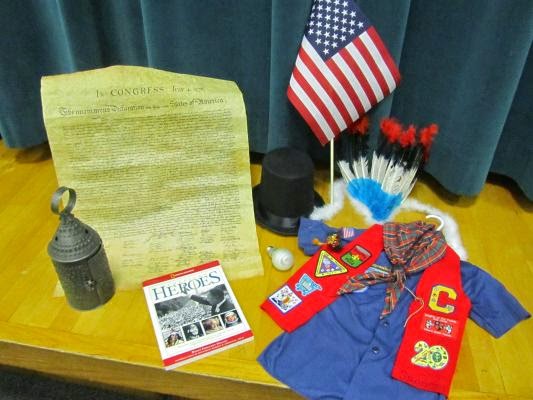
Preparation: Find the prop for each person and write what they are going to say on a card.


Narrator (opening a history book to read): Come join me now for just a minute while we look for heroes in history in my book. There are many heroes on these pages with tales of deeds through the ages.

Thomas Jefferson ( three-cornered hat or Declaration of Independence): I am Thomas Jefferson. The Declaration of Independence I did write, helping our country in its freedom fight.

Squanto (Indian headdress): I am Squanto. I helped the Pilgrims to stay alive that first winter in their
struggle to survive.

Neil Armstrong (astronaut helmet or hand-held flag): I am Neil Armstrong. I helped to blaze the trail into space for our land, and I was the first person on the moon to stand.

Abe Lincoln (stovepipe hat): I am Abraham Lincoln. As president, my best to the country I gave, and
helped to end the War Between the States.

Thomas Edison (lightbulb): I am Thomas Edison. I did my best to help my land without wait; the electric light I did create.

Paul Revere (lantern): I am Paul Revere. I made a famous ride to every farm to warn of the British and spread the alarm.

Cub Scout (in uniform): All these men who blazed a trail did their best and did it well. We are the future trailblazers of this land. You can bet we'll do our best to do our job grand!

Training Topic
Safe Scouting: The Rules That Keep Your Scouts Safe

Discussion leader should show the Guide to Safe Scouting, No. 34416C, to the Cub Scout leaders.
• Ask who in the class is familiar with the guide and its contents.
• Select several Cub Scout activities and discuss with the class how the guide addresses the safety issues of these activities.
• Discuss why Scouting places such emphasis on safety.
• We, as leaders, should model safe behaviors.
• Review the reporting procedures in the event of an accident.
• Discuss the BSA Annual Medical Form. The use of this form can help to assure that the boys are
healthy enough to participate in Scouting activities.
• Review the age-appropriate guidelines.
• Review two-deep leadership requirements.
• Youth protection begins with “You”!
• Adult leaders must repeat the course every two years.
Resources:
• Guide to Safe Scouting, No. 34416C
• Safety Thoughts—scouting.org
• Youth Protection training—www.scouting.org/Training/YouthProtection.aspx

Audience Participation Song
“American Legends”

Tune: “Davy Crockett”

Born on a mountaintop in Tennessee,
Greenest state in the land of the free.
Raised in the woods where he knew every tree
Killed him a bear, when he was only three
Davy, Davy Crockett,
King of the wild frontier.

Walked across the country with a sack on his back,
Saved Ohio settlers from Indian attack.
Shared all he had with anyone who lacked,
Apple trees now mark the path where he walked.
Johnny, Johnny Appleseed,
King of the farming man.

Made his living laying railroad rails,
The strongest man who could hammer those nails,
Then he was challenged to the race of his life,
Outworked a steam drill, but didn’t live through the night.
Big John, Big John Henry,
King of the railroad man.

Raised by coyotes and schooled by a bear,
His horse was a Widowmaker to those who dared,
Roped every varmint that flew through the sky,
Even a cyclone ‘cross the prairie he’d ride.
Pecos, Pecos Bill
King of the wild, wild west.

Commissioner’s Minute
Real Strength

America’s history is dotted with famous people—men and women and even children. We gain
inspiration from their stories. America’s strength has always been in her people. It took character to
survive that first winter in Plymouth, and another bad winter at Valley Forge. It took character to put
belongings into a rickety old wagon and push off into a land of vague promise. It took character to
tell a nation that slavery was wrong. Because character is needed today more than ever before, the
Boy Scouts of America is concerned about building strong character in boys. The BSA wants to help
guarantee that America is as strong in the future as it was at its birth. Our heroes in history show us
examples of great character. Cub Scouts can be the heroes of tomorrow as they learn about and develop that same character.

Cheers

Henry Ford cheer: Stand, pretend you are turning the crank on a Model T car (make chugging noises), then let out a big engine “ROAR” and sit down. Take the steering wheel and drive, blowing the horn with one hand and saying, “Aah-oo-gah!”
Paul Bunyan cheer: Divide the audience into two groups, the Chips and the Chops. As you point to each group, they yell in unison either “Chip!” or “Chop!” Repeat faster and faster until the tree is chopped down, then all holler, “Timber!”
Casey Jones Railroad cheer: CHOO, CHOO, CHOO, CHOO, CHOO, CHOO! WHOOOO! WHOOOO!
Grand Salute cheer: Slap your knees five times and count, “1-2-3-4-5,” then stamp your feet five
times as you count, then stand up and salute.


Closing Ceremony
Johnny Appleseed

Materials: An apple for each family or each Cub Scout or everybody. Your choice!
Johnny Appleseed was a pioneer hero, one of the very best. He didn't look much like one.
He was small and not very strong. He wore a tin pot for a hat and a coffee sack for a coat. Under his arm he carried a Bible and over his shoulder, a bag of apple seeds.
He had no knife. He had no gun. But he walked through sunshine and walked through rain--over the mountains, over the plains, and through forest trails knee-deep in mire looking for places to plant apple seeds.
While he was working, he thanked the Lord for giving him "the sun, the rain, and the apple seed." As legend goes, God was so pleased with Johnny Appleseed's selfless service that He put in the middle of every apple a star.
As we close our meeting, I will give each person an apple and ask that when you get home you slice the apple in half (demonstrate this) as I just did. You will see the star given to Johnny and to you for being part of our pack.


Monday, May 12, 2014

Courage/Space-the New Frontier

Core Value: Courage
Theme:"Space-the New Frontier"

July Pack Meeting Plans:
“Courage” AND “Space—the New Frontier
Pack Meeting Plans

Gathering Activity
Planet Quiz

Materials:

As families enter, have a preassigned den hand out a copy of the planet quiz to each family. Set out
pencils on tables. Explain that each family should work together to find the answers to the quiz. Work
together as a family to find the answers to the following questions.

1. I am extremely hot and very dry. I am closest to our sun.
 I am a small planet. My diameter is half of Earth’s.
 I am named after the speedy messenger of the ancient Roman gods.
 What planet am I? ____________________

2. I am the eighth planet from our sun.
 I am the fourth-largest planet in diameter.
 I was named for the ancient Roman god of the sea.
 What planet am I? __________________

3. I am the sixth planet from our sun.
 I orbit the sun in 11 of Earth’s orbits.
 I have thousands of rings made of tiny particles of floating ice circling me.
 What planet am I? _______________

4. I have been called the “evening star” or “morning star,” even though I am a planet.
 I am surrounded by thick clouds filled with droplets of sulfur.
 I am Earth’s sister planet—almost the same size as Earth and the second planet from our sun.
 What planet am I? _________________________

5. I have 50 official moons—maybe more.
 I am the fifth planet from our sun.
 I am named after the king of the ancient Roman gods.
 What planet am I? ___________________________

6. I have a tilted rotation around the sun—my north and south poles are where the equator is on Earth.
 I have 27 known moons.
 I am the seventh planet from the sun.
 What planet am I? ______________________

7. I am the biggest of all the terrestrial planets. A terrestrial planet is a dense planet found in the inner
solar system.
 About 30 percent of my surface is covered with land, while about 70 percent is covered by water.
 I am the third planet from our sun.
 What planet am I? __________________________

8. Recently, evidence of ice water was found on me.
 I used to be called the “red planet” because I appear red when viewed through a telescope.
 I am the fourth planet from the sun.
 What planet am I? _____________________

Answer key: 1) Mercury, 2) Neptune, 3) Saturn, 4) Venus, 5) Jupiter, 6) Uranus, 7) Earth, 8) Mars.

Opening Ceremony
Out in Space

Setting: Four Cub Scouts are standing on stage looking up to the sky.
Cub Scout 1: What’s out in space?
Cub Scout 2: Mostly lots and lots of space, but also billions and jillions of stars, galaxies, and solar
systems, planets and moons, blazing comets, and deadly rays.
Cub Scout 3: (Walks out dressed in a space helmet and says these famous words of Neil Armstrong): One small step for man. One giant step for mankind.
Cub Scout 4: That’s what’s out in space!
Let’s all stand and remember the American flag flying on the moon. Please join with us in the Pledge of Allegiance.

Training Topic
Ideas for telling Cub Scout leaders, "Thank you!"

1. Give them a Milky Way bar and tell them they are “Out of this World.”
2. Boys make and write a thank you card for their leaders.
3. Make a video clip of the boys telling what they like and their favorite experience they had in Wolves, Bear and Webelos. Show it at a pack meeting.
4. When a new cub scout is introduced to the pack, give the mother a ribbon or ribbon necklace with to put their Mother’s Pins on.
5. Use a prescription empty container. Write Thank you being a Cub Scout Leader and Here are some
special pills to help you get through the next year. Then put skittles, or M&M’s in it. Have each color
represent a character trait you will need to get through cub scouts. Green will make you silly. Blue will help those creative ideas flow, etc.
There is any number of very nice awards that can be purchased from your local Scout shop.
Flowers and plants are always great.
Certificates can be custom-made on your own computer.
Crazy/gag awards are fun and inexpensive. For example:A wooden plaque with a mounted light bulb and sign: “Thanks for your bright idea!” Little bag of Hershey’s kisses with a tag: “We love the help you gave us!”  Bag of Reese’s Pieces with tag: “We all love you to pieces.”
Small ruler with tag: “You rule!”

Audience Participation Activity
Round the Moon

All the dens line up at the end of the room. Each Cub places his hands on the waist of the Cub in front so the dens form a “rocket.” A chair is placed at the far end of the room opposite each den; these are the moons. On “Go,” the dens run the length of the room, around their moon, and back into orbit. As they pass base, the “rockets” drop a section each time and the Cub Scouts sit down there one by one, until finally the “nose cone”—the first in line—returns home. The first team to be sitting down is the winner.

Commissioner’s Minute

The beach ball was a visual for the size of the first Soviet Union satellite that was sent into space. -
History changed on October 4, 1957, when the Soviet Union successfully launched Sputnik I. The world's first artificial satellite was about the size of a beach ball (58 cm.or 22.8 inches in diameter), weighed only 83.6 kg. or 183.9 pounds, and took about 98 minutes to orbit the Earth on its elliptical path. That launch ushered in new political, military, technological, and scientific developments. While the Sputnik launch was a single event, it marked the start of the space age and the U.S.-U.S.S.R space race.

Astronaut Eggs

Materials: Eggs; resealable bags, tape; Styrofoam sandwich box; packing materials such as cotton,
newspaper, peanuts, grass, leaves, etc.
Scientists spend a lot of time making an astronaut’s journey safe. For the preopening activity, have the Cub Scouts pack an egg so that it can survive a 10-foot drop onto a hard surface. Put the egg inside the resealable plastic bag, then pack it any way you want inside the box. Tape the box well, and write scout’s name on it. Drop the boxes from a balcony, or high place, then check to see whose egg survived.

Cheers

  • Rocket (all: ZZZZZZZZZOOOOOOOOOMMMMMM!)
  • Wizard of Oz (Remember the lion in the Wizard of Oz? He was looking for courage. Everyone link arms and let’s all say “We’re off to see the wizard!”)

These ideas were shared at Round Table
Activities that go along with the Space Theme

1. Water rockets (Fill up 2 liter bottles with water and shoot them up in the air. Great summer activity
when it is hot outside)
2. Balloon rocket (Attached a straw to the balloon which will slide along the strung string tied between
two sturdy holdings. This was done at the Cub Scout Day Camp during spring break this year).
3. Make Regular Rocket kits and shoot them up in the air
4. Gilbert Rotary Centennial Observatory at the Riparian Institute. They offer private session in one-
hour time slots. A maximum of 20 people can be scheduled for any one session. Cost is $5/person. The minimum fee is $45.00. However, Organized youth groups working on astronomy awards, such as Boy Scouts, Cub Scouts, or Girl Scouts, or any other formally organized and recognized youth group should contact grco@evaconline.org for specific arrangements and/or possible fee waivers. http://gilbert-news-blog.dailyprss.com/index.php/2013/06/21/the-gilbert-rotary-centennial-observatory-at-the-riparian-institute/
5. There is a solar walk at Veterans Oasis Park in Chandler. - The solar walk is a scale representation of the major objects in the solar system set up along a 2,500-foot pathway around the lake. The objects are spaced at distances relative to their scale in the solar system. Each foot represents 1.5 million miles in space. For example, the distance between the earth and the sun along the solar walk will be 62 feet, representing the actual 93 million miles. The map and more information can be found at http://chandlersolarsystemwalk.com/home.html. They also set up telescopes on the side walk from time to time. See web site for dates and times.
6. MCC Planetarium

Tuesday, April 8, 2014

Health&Fitness/Destination Parks & Perseverance/Over the Horizon

May's Core Value: Health and Fitness
May's Theme: Destination Parks
June's Core Value: Perseverance
June's Theme: Over the Horizon


May Pack Resource Sheet (begins on p. 104)
May Pack Meeting Plans: “Health and Fitness” AND “Destination: Parks
June Pack Resource Sheet (begins on p. 108)
June Pack Meeting Plans: “Perseverance” AND “Over the Horizon

Gathering Activity
Kim’s Game (Hiking Items)

This game uses items you should always take on a hike such as a whistle, flashlight, map, compass,
trail mix, candy, plastic water bottle, trash bag, pocket knife, adhesive bandage, moleskin, antibiotic
ointment, safety pins, sunscreen, and matches. These are also the “outdoor essentials” for hiking. Cover the items with a sheet or large towel when Scouts arrive. For the game, have Scouts gather around the table. Lift the cover and give Scouts 30 seconds to study the items. Replace the cover over the objects and have the Scouts return to their seats. Then have them raise their hands and identify one object they saw, taking turns until all of the items have been identified.

Opening Ceremony
Four Directions

Materials: Four Cub Scouts, each with a poster with a large letter for his direction on it. On the back, the following is written for each boy to read.

Cubmaster: Finding our way to our destination in the park is aided by the use of a compass, which shows the four directions—north, south, east, and west.

(Each Cub Scout enters from his side of the room or outdoor area, holding one of four posters. with a
large letter for his direction on it. On the back, the following is written for each boy to read):

Cub Scout 1 (“E”): I represent the East. From me comes the sun each day, giving light to all living things to help them to be strong and healthy.

Cub Scout 2 (“S”): I represent the South. From me comes heat and rain, so all living things have warmth and water to drink.

Cub Scout 3 (“N”): I represent the North. From me comes cold and snow, so all living things can
experience coolness and the beauty of winter.

Cub Scout 4 (“W”): I represent the West. To me, the sun comes at the end of each day, giving the world darkness so all living things can rest.

Cubmaster: We gather from all directions, joined together in the Law of the Pack. Will everyone please stand, give the Cub Scout sign, and join me in reciting the Law of the Pack.

Training Topic
Chartered Organization Relationships

• The foundation of BSA’s unit structure is the chartered organization.
Who are some of the chartered organizations in our local district?
• There is much more to sponsoring the unit than providing a place to meet.
—The chartered organization has selected Scouting as a key to achieving its purpose and mission in the local community.
—The chartered organization may be a church, civic group, school, or other such organization that works in conjunction with the BSA to provide an outreach program for youth.
—The chartered organization is effectively a “franchisee” or “owner-operator” of the Scouting program.
• By receiving a charter from the Boy Scouts of America, the chartered organization agrees to do several things:
—Conduct Scouting in accordance with its own policies and guidelines as well as those of the BSA.
—Include Scouting as part of its overall program for youth and families.
—Appoint a chartered organization representative who is a member of the organization and will
represent it to the Scouting unit as a voting member of the district and council.
—Select a unit committee of parents and members of the organization who will screen and select unit
leaders who meet the organization’s leadership standards as well as the BSA’s standards.
—Provide adequate and secure facilities for Scouting units to meet on a regular schedule with time and place reserved.
—Encourage the units to participate in outdoor experiences.
• Building this relationship can be a richly rewarding opportunity for both the chartered organization
and the Scouting unit, but it requires effort by both parties.
—The unit encourages greater support from its chartered organization.
—The unit can show its appreciation of the chartered organization’s generous support through service
and other events important to the chartered organization.
• Begin by working closely with your chartered organization representative.
—Every BSA unit should ensure the chartered organization representative is kept current with unit
events and future plans.
—The chartered organization representative should be invited to committee meetings, and better yet,
be an active part of the unit committee.
—Encouraging open communication and seeking the advice of your chartered organization
representative helps the unit become an integral part of the chartered organization.
—What are some examples of ways your unit serves its chartered organization?
• It is also an opportunity for the chartered organization to use Scouting to further its goals.
—For a religious institution, Scouting may be a part of its youth program.
—A parent organization, such as a local PTA or home schooling organization, may use Scouting to serve educational aims with a high-quality, values-based program.
—Local civic groups often serve as chartered organizations for Scouting units as part of their community service initiatives.
• Voice of the Scout data indicates that BSA chartered organizations believe strongly in the program, but they frequently reported wishing the units did more for their institutions.
• How might a Scouting unit show its gratitude though increased support of its chartered organization?
—Assist the chartered organization as part of an annual service day that includes grounds and facilities maintenance.
—Help with decorating for religious holidays or community events, such as Veterans Day or Fourth of July, in accordance with the chartered organization’s interests.
—Help at fundraising events with volunteer service, such as assisting with a pancake breakfast or chili dinner that benefits a chartered organization’s initiative.
—Participate in Scout Sunday and Scout Sabbath in uniform.
—Participate in community parades, rallies, or special events in conjunction with the chartered
organization.
—Other special service opportunities and projects are good ways to show the unit’s appreciation.
—Close dialog with the chartered organization representative can identify which opportunities are
appropriate for the unit to support and how.
• If the unit is not currently engaged in service back to its chartered organization a few times a year,
it may be wise to sit down with your chartered organization representative and ask how your unit can
more actively give back to the organization.
• Building a healthy relationship based on mutual support allows both organizations to maximize the
benefits of Scouting in our communities.
BSA Reference Materials
• BSA Chartered Organization Agreement, No. 524-182
• The Chartered Organization, No. 32196
• The Chartered Organization Representative, No. 33118
• Training for the Chartered Organization Representative should be available through the local council.
www.scouting.org/Media/Relationships/TrainingtheCOR.aspx

Audience Participation Activity
Goin’ on a Scout Hike

Have the audience repeat each line and action after the leader:

We’re goin’ on a Scout hike. (Feet marching.)
We’re getting to the tall grass. (Rub palms of hands back and forth.)
Up ahead there’s a bridge.
Here we go across the bridge. (Hit chest with alternating fists.)
We’re across the bridge. (Resume marching.)
We’re going up a big hill. (Slow march, heavy breathing.)
We’re on the top now, here we go down the other side. (Speed up march.)
Now we’re on level ground. (Regular marching.)
More tall grass. (Rub palms together.)
Shh! Looks like wolf country! (Stop.)
I hear a howl. (Hand to ear.)
Let’s go!

(At a fast tempo, repeat all actions and gestures in reverse order (hand to ear, stop, rub palms together, regular marching, speed marching, slow marching and heavy breathing, resume marching, hit chest, rubpalms back and forth, marching) until everyone is back home.)

It sure is a good thing we are all healthy and fit—sometimes a good walk can become a quick run!

Commissioner’s Minute
Magnetic Influence

How many of you have learned to use a compass? You know that the needle points North and will guide you in the wilderness, but have you also seen what happens when a magnet is brought near the
compass? What happens? The magnet is an outside influence on the character of the compass.
Each of us has an aim in life. In Cub Scouts we teach that that aim is to do our duty to God and country, to help other people, and to obey the Law of the Pack. The Cub Scout core values like faith, compassion, honesty, and perseverance make up the magnetic field that directs the compass needle we follow.
Just like the magnet, there are influences trying to change our aim. There are temptations difficult to
overcome - temptations to get by without working, to lie, to cheat, to follow the coaxing of friends, and the jeers or threats of enemies.
We must not succumb to the attraction of these magnets in our lives, but must be steadfast in our
purpose of living up to the values of Scouting. There is safety and peace as we follow our true moral
compass.

Cheers

Compass (Everyone pretend they are holding a compass in their hand, getting their bearings. Then each person points in a direction they choose and calls out “Way to Go!”)

Clap and Stamp Feet (Have the group stand and clap hands three times, then stamp feet three times,
then repeat, faster and faster.)

Big Bear Hug (Put your arms around your shoulders and give yourself a big bear hug.)

Clean Air (Take in as much air as you can through your nose, hold it, then exhale and say, “Ahhhhh!”)

Sand Sculptures

Materials: 1 cup play sand, ½ cup cornstarch, ¾ cup hot water, 1 teaspoon powdered alum, a saucepan.

Directions: Mix the sand, cornstarch, and alum in a saucepan. Add hot tap water. Stir quickly until
mixed. Have an adult cook the mixture over medium heat. Keep stirring until the mixture becomes thick. Let it cool. Mold the mixture into the desired shape. When finished, place the sculpture on a windowsill or somewhere it will get plenty of sunshine. Let it dry for several days. The sand sculpture will get so hard it won’t have to be sprayed with anything to protect it. It will last forever!


Friday, March 14, 2014

Faith/My Family Tree


At March's Round Table we shared ideas for
April's Core Value and Theme
Core Value: Faith
Theme: My Family Tree


April Pack Resource Sheet (begins on p. 100)

April Pack Meeting Plans: “Faith” AND “My Family Tree”

Gathering Activity
Where Are You From?

Materials: Large U.S. map and world map. Direct participants to the maps mounted on a wall or easel. Ask them to put a pushpin in the maps indicating where they grew up and in the place where their ancestors lived. See how many states and countries we come from!

Opening Ceremony
Family Tree

Personnel: Six Cub Scouts and Cubmaster

Materials: Large cutouts of leaves each with a letter from the word “family” written on them. A large
“tree trunk” (carpet roll, papier mâché). After the opening, the tree trunk will be positioned on stage
so the word “family” remains visible for throughout the pack meeting.

Cub Scout 1: F is for FAMILIES we belong to.

Cub Scout 2: A is for ANCESTORS and all who have come before us.

Cub Scout 3: M is for the MANY things that we can learn from them and about them.

Cub Scout 4: I is for the INDIVIDUALS who make up each family.

Cub Scout 5: L is for the LEGACY we can leave through service and good works.

Cub Scout 6: Wait a minute! Isn’t there something missing?

Cubmaster: Yes! Y is for YOU! (Cubmaster gives Cub Scout 6 the leaf with “Y” on it. Cubmaster positions the trunk of the tree. The Cub Scouts place their leaves on the tree.)

Cubmaster: We need YOU to make our pack family complete!

ALL: Let’s honor our ancestors and legacy by reciting the Pledge of Allegiance to our flag. (Everyone stands and recites.)

Training Topic
Reverence and Religious Emblems

• Ask: “Which of the following chartered organizations worked with the most traditional Scouting units in 2011?”

a. Civic

b. Religious

c. Educational

—Answer: (B) Religious (69.39%); Civic (22.74%); Educational (7.87%)

• BSA is a faith-based organization—Duty to God and the Declaration of Religious Principle

—Tiger Cub Handbook Elective 8—Your Religious Leaders

—Cub Scout Core Value—Faith (having inner strength and confidence based on our trust in God)

—Wolf Handbook Achievement 11: Duty to God

—Bear Handbook Achievement 1: Ways We Worship; achievement 2: Emblems of Faith

—Webelos Badge Requirement 8: Your Religious Duties

—Scout Oath

—Scout Law—12th point is “Reverent.”

• Religious awards are sanctioned by the BSA and allowed to be worn on the uniform but are not
Scouting awards.

• Religious awards are earned and confirmed by religious leaders.

• Religious awards are age-appropriate.

—Youth can earn the first-level emblem as a Tiger Cub or Cub Scout.

—Webelos can earn the second-level emblem.

—Boy Scouts can earn the first- and second-level religious emblems for Boy Scouts.

—Older Boy Scouts, Venturers, Varsity Scouts, and Sea Scouts can earn the second level emblem.

• Benefits of earning religious awards:

—Character development is one of the three purposes of the Boy Scouts of America.

—Strengthens family ties through family involvement

—Strengthens Scout’s religious ties through guided exploration and learning

—Opportunities for leadership positions (chaplain aide) in troops

—May lead to a faith-based career—pastor, priest, rabbi, imam, counselor, etc.—or service to the
religious institution in non-ordained roles

• The council and district religious emblems coordinators are adult leader positions; they encourage all youth to earn the emblem of their faith.

• Display slide/poster of youth religious awards, youth religious emblem square knot, and adult religious emblem square knot.

• Ask: “What do these square knots represent and who can wear them?”

—Answer: Youth wear youth religious emblem square knots to prevent loss or damage to their award.

• A silver knot on a purple background is worn by youth, and a purple knot on a silver background is worn by adults.

• If a Scout earns more than one religious emblem, he only wears one square knot with the appropriate device(s); (Cub Scout, Webelos Scout, Boy Scout, and Venturing).

• Display websites for a variety of religious organizations.

BSA Reference Materials

• P.R.A.Y. Publishing: www.praypub.org

• National Catholic Committee on Scouting: www.nccs-bsa.org/

• National Jewish Committee on Scouting: www.jewishscouting.org

• The National Islamic Committee on Scouting: www.islamicscouting.org/

• BSA Religious Awards: www.scouting.org/Awards/ReligiousAwards.aspx

• Guide to Awards and Insignia: No. 614937

• Religious emblems coordinator: www.praypub.org/REC/

Duty to God

Suggested discussions questions and information to be covered and included in the discussion:

1. What does duty to God have to do with Cub Scouting?

• “The Boy Scouts of America maintains that no member can grow into the best kind of citizen without recognizing an obligation to God and, therefore, recognizes the religious element in the training of the member, but it is absolutely nonsectarian in its attitude toward that religious training.Its policy is that the home and organization or group with which the member is connected shall give definite attention to religious life. Only persons willing to subscribe to these precepts from the Declaration of Religious Principle and to the Bylaws of the Boy Scouts of America shall be entitled to certificates of membership.” (Excerpt from the Declaration of Religious Principles, included in “Information for Parents” inside the front cover of the BSA youth application; also included in the adult application.)

• The Cub Scout Promise states: “I, (name), promise to do my best to do my duty to God and my
country, to help other people and to obey the Law of the Pack.”

2. How does the Cub Scout program include duty to God?

• Boys must complete Duty to God requirements to earn their Wolf (Achievement No. 11), Bear
(Achievements Nos. 1 and 2), and Webelos (Requirement No. 8) badges.

• Faith is the Cub Scout Core Value for April every year.

3. How else can duty to God be worked into the Cub Scout Program?

• Say grace before meals (nonsectarian).

• Have an opening prayer at pack meetings (nonsectarian).

• Hold a “Scout’s Own” service at family camping events.

• Plan and conduct an annual Scout-oriented religious observance during Scout week in February.

• Recognize God’s work in the things that He made, such as animals, plants, and the beauty of the
outdoors.

• Participate in den or pack service projects that help other people.

4. Are there any Cub Scout awards or recognitions that have to do with duty to God?

• Religious emblems programs have been developed by numerous religious groups to encourage their
Scouting members to grow stronger in their faith.

• These emblems are available for the different levels of the Scouting program, with age-appropriate
requirements. The BSA has approved of these programs and allows the emblems to be worn on the
official uniform. The various religious groups administer the programs.

• Check with your local council service center or contact the religious organization directly to obtain the curriculum booklets and to find out who teaches the program in your area.

Resources:

• Grace before meals   (http://www.boyscouttrail.com/graces.asp)

• Scout’s Own Services (samples available at http://macscouter.com/scoutsown/)

• Duty to God Religious Emblems: full-color brochure, available online at www.scouting.org/filestore/pdf/512-879_WB.pdf

Audience Participation Activity
Song:“Family Trees”

Tune: “Head, Shoulders, Knees, and Toes”

Leaves, branches, trunk, and roots, trunk and roots,

Leaves, branches, trunk, and roots, trunk and roots,

We’re studying our family groups.

Leaves, branches, trunk, and roots.

(After each has mastered the words, sing it faster. Then add action):

Leaves: point to head

Branches: point to shoulders

Trunk: point to waist

Roots: point to legs

Studying: put hands to together as if reading a book

Family groups: arms spread out wide

Commissioner’s Minute

“When a society or civilization perishes, one condition can always be found. They forgot where they
came from.” Carl Sandburg

“If you don’t recount your family history, it will be lost. Honor your own stories and tell them, too. The tales may not seem very important but they are what binds families and makes each of us who we are.” Madeleine L’Engle

Cheers

Newton’s Apple: Hold your hand above your head as if holding an apple. Let the apple fall (make sound effect!) onto your head and jolt you awake. Pick up apple, look at it, and exclaim, “Great idea!”

We Are Family: Everyone stands and places their arms around the shoulders of their neighbors.
Everyone sways back and forth, chanting “We Are Family.”

Brown Paper Lunch Sack Family Tree

1- Cut lunch bag into half inch strips. Start at the opening and cut half way down the bag.

2- Open bag and stand it up.

3- Hold base of bag with one hand and twist the middle of bag to create the trunk of the tree.

4- Twist two of the bag strips together to create branches.

5- Cut out leaf shapes, write family names on the, and glue them all over the branches of the tree.


My Family Sticks Together

1-Select a 6-8 inch stick to represent each member of the family.

2-Glue google eyes on each stick.

3-Tie the sticks together with jute or twine.

4-Add a sign that says “My Family Sticks Together."


Monday, February 24, 2014

Compassion/Pet Pals


At February's Round Table we shared ideas for
March's
Core Value and Theme
Core Value: Compassion
Theme:Pet Pals


March Pack Resource Sheet (begins on p. 97)

March Pack Meeting Plans "Compassion" and "Pet Pals"

Gathering Activity
Animal Scramble

Materials:

One index card per player, pencil or pictures of animals, tape or pins

Write the names of common animals on index cards or put a picture of the animal on each card. (Pictures will allow younger children to give more accurate answers.) Pin or tape the card on the back
of each player’s shirt. Players ask questions of other players to get clues to their own identities. They should ask only one question of each person and have that person ask one question of them so they can mingle with the other players. Answers are limited to “yes,” “no,” maybe,” and “I don’t know.” Players continue to ask questions to discover characteristics about their animal until they are able to guess who they are. A player might ask questions such as: “Am I a predator?” “Do I have a tail?” “Do I have four legs?” “Am I active at night?” “Do I live in the forest?”

Opening Ceremony
Always Do Your Best

Cub Scout 1: A good Cub Scout remembers to feed a pet and take care of it always. (Holds up card that says “Always.”)

Cub Scout 2: Pets need company and someone to play with. Left alone, a pet becomes lonely. Playing and spending time with your pet is the right thing to do. (Holds up card that says “Do.”)

Cub Scout 3: Always remember that your pet needs your care and it is your responsibility. (Holds up card that says “Your.”)

Cub Scout 4: Pets often learn to greet you when you get home from school. Knowing that a pet likes to be with you is the best. (Holds up card that says “Best.”)

ALL: With your pets, always Do Your Best!


Den Displays


Pack Meetings are an opportunity for the boys to show-off what they've learned or made during the past month's Den Meetings. A display table will be available at each pack meeting so that the boys can display the crafts or projects they have worked on that month. The display tables allow families and other dens to see what has been made and what to look forward to.

Training Topic
New Cub Scout Adventure Program

Adopt the Scout Oath and Law for use in the Cub Scout & Venturing program, retiring the Cub Scout
Promise & Venturing Oath.

– Revise the Core Values of Cub Scouts to align exactly with the twelve points of the Scout Law.

– Retire the Law of the Pack, while maintaining the concept of “Akela” as leader.

– Maintain the current Cub Scout motto, sign, salute, and handshake.

Rank Advancement Through Adventures

• For each rank, complete seven den-based adventures, including a family-based “Duty to God” adventure, to earn rank

• Adventures = interdisciplinary, theme-based experiences, 3 den meetings

• Immediate recognition after each adventure (TBD)

• Elective adventures available; same recognition approach

Cub Scout Change Summary

NOT Changing

• Family focus

• Ranks or approach

• Ages (or genders)

• Den/pack meeting structures

• Outdoor program

• Delivery model

• Fun – even more than before

CHANGING

• Oath & Law

• Tiger Cub becomes Tiger with new image

• Arrow of Light will no longer require earning Webelos

• Activities – more active, more aligned with Aims/Mission

• Advancement – simplified

• Academics & Sports program discontinued (5/15)

• Current immediate/elective recognition devices replaced

• One Den Leader Guide per rank

Audience Participation Activity
Skit:Invisible Pet

Materials:

Three Cub Scouts

Cub Scout 1 (dragging a leash behind him): Come on boy, let’s go.

Cub Scout 2: What are you doing?

Cub Scout 1: I’m taking my dog for a walk.

Cub Scout 3: I don’t see any dog. You’re just dragging a leash along.

Cub Scout 1: That’s because it is an invisible dog.

Cub Scout 2: Invisible dog?!

Cub Scout 1: My mom says I can have a real dog if I learn to be responsible and take care of it. I have to feed him, and walk him and just be his friend. If I do that, then my folks will take him to the vet and get all his shots.

Cub Scout3: So you are just practicing on a pretend dog at first?

Cub Scout 1: I am NOW. The pretend elephant was just WAY too much work!

Commissioner’s Minute

All I Really Need to Know I Learned From My Dog
Here are some examples:

• When loved ones come home, always run to greet them.

• Run, romp, and play daily.

• Be loyal.

• If what you want lies buried, dig until you find it.

• When you leave your yard, make it an adventure.

• Bond with your pack.

• When you’re excited, speak up.

• When you’re happy, dance around and wag your entire body.

• Sometimes a bark is worse than a bite.

• Accidents happen.

• Play nicely with others and they’ll play nicely with you.

• Stop and smell the roses, the dirt, and the grass.

Cheers


Cat’s Meow (You’re the cat’s MeeeeOOOOW!)

Alligator (Alligator opens his mouth very slowly, then snaps shut very fast. Both hands together start
opening from fingers and palm, keeping wrists together, then snap hands together very fast. Repeat 3
times)

Beehive (Leader instructs everyone to start humming. When he raises his hands, the humming gets
louder. When he lowers his hands, the humming gets quieter.)

Mosquito Applause (With hand, slap yourself on the neck, arms, legs, etc.)

Puppy Dog (Bark three times and then stick your tongue out and pant like a dog.)


Sunday, January 12, 2014

Resourcefulness/Invention Convention

At January's Round Table we shared ideas for
February's Core Value and Theme
Core Value: Resourcefulness
Theme:Invention Convention


February Pack Resource Sheet (begins on page 93)

February Pack Meeting Plans: “Resourcefulness” AND “Invention Convention

Gathering Activity
Geometrical Structures


Put out mini-marshmallows and toothpicks for building geometrical structures. These can also be used on the tables at Blue and Gold. The Scouts and their guests will build their own centerpieces!


Print out Cub Scout Core Value coloring sheets


Opening Ceremony
Invention Convention


  (Link to Inventor Cards)

Materials: Cubmaster and six Cub Scouts holding cards with their assigned letter and a picture of the
invention on front and script on back.

Cubmaster: This month’s theme is “Invention Convention.” And we have something to tell you about some genius inventors.

Scout: “G” is for Gutenberg. He invented movable type for printing, so that we can have books, papers, and magazines to read. He was resourceful in applying what he learned from others.

Scout: “E” is for Edison. He gave us many electrical ideas, but perhaps his greatest was the light bulb to help light up our world. He was resourceful in using over 1,000 different materials before finding the one that worked.

Scout: “N” is for Newton. He discovered gravity and worked with electricity. He was resourceful, using that apple for inspiration.

Scout: “I” is for Irving. He was a genius with his pen. He wrote many stories, which young and old have enjoyed for ages. He was resourceful in learning about where he lived.

Scout: “U” is for Urey. He made his discoveries in chemistry and nuclear power, which will be used for many generations. He was awarded the Nobel Prize in 1934 for his discoveries.

Scout: “S” is for “Scouting,” which helps every boy develop genius in his very own way. Cub Scouts are always resourceful when they do their best.

Cubmaster: Now let us salute the genius that is in every boy by standing and saying our pledge to the flag of our country.

Genius Kits

What Is a Genius Kit?

It’s a group of 20 or more odds and ends thrown together into a container and given to a boy so he can turn the pieces into a creation of his own. (Variations include letting the boys pick their own items from a large open container of odds and ends.)

The object of the genius kit activity is to let the kids use their imaginations to come up with the most unbelievable creation using only the items in the kit. You will be amazed at the results!

How do you run a genius kit activity? It can be run in two different ways: One is to give the kids a chance to pick their own items from a general junk bin, and then let them work on making their creations. The other way is to give each boy an identical genius kit and have each one come up with his own creation. You can also customize rules depending on how you want to conduct the event.

For example, when all the boys have the same items, you might want to instruct the boys that only the materials supplied and clear glue can be used. This keeps them from adding to their creations so you can maintain a level playing field.

Finally, this activity doesn’t lend itself to a large group setting. The hot glue and white glue can end up everywhere and might hurt someone. You might choose to have the boys work on the projects at home and bring them in for display and judging. To judge the projects, create several categories and be generous with ribbons.

Training Topic
Advancement: Role of Family and Leaders

Introduction:

 When parents sign their son’s application to join Cub Scouting, they are also agreeing to help with
advancement for their son. There is a reason that the No. 1 indicator for success in Journey to Excellence is advancement. A good program that supports advancement for boys also provides the basis for retention and a number of measurable outcomes for the pack.

•Opening question:

What do we mean by advancement?

 —Response should include information on activities and also stress that it is more than signing off on achievements. It is “not what the boy does to the wood, but what the wood does for the boy.” Make sure boys are learning and growing as they work towards advancement.

•Follow-up question:

How is it measured?

 —Response may include use of the books, signing of activities, and presentation of badges/patches.
Repeat that advancement is a method used by the BSA to accomplish its mission: “The mission of the
Boy Scouts of America is to prepare young people to make ethical and moral choices over their lifetimes by instilling in them the values of the Scout Oath and Law.”

•Follow-up question:

How does your annual plan support advancement?

 —Responses may include planning activities that will support achievements or elective completion for boys, such as those found in Cub Scout day camp and resident camp activities, as well as pack outings.

I just wanted to show you some ideas of ways to keep your pack on track and make sure boys are
advancing in the Cub Scouting program.

•Show the JTE scorecard—the first item is advancement.
•Show the district advancement reporting paperwork and discuss Online Advancement for the unit.
•Show the Guide to Advancement as a resource for Cub Scout advancement chairs.
•Highlight the parent responsibilities as found in the Cub Scout Leader Book, Chapter 5: Family
Involvement.

“Families are the basis of our society. In the family, children learn about love, values, and social
interactions while they prepare for today’s world. The family is vital to the future of our communities and our nation. The Boy Scouts of America has a great interest in the strength of the family. Cub Scouting is a family program. Family involvement is vital to Cub Scouting’s success.”

Ideas of how to involve families?

Here are some examples of family involvement:

• Working with their Cub Scout on advancement projects and activities
• Attending pack meetings with their Cub Scout
• Presenting advancement awards to their Cub Scout at pack meetings
• Becoming a leader
• Providing ways for their Cub Scout to earn money he needs for den dues
• Helping at an occasional den meeting on a specific project or activity badge
• Providing refreshments
• Providing transportation
• Assisting with den outings
• Telephoning
• Helping teach a Webelos activity badge
• Attending a council-organized family campout with their Cub Scout
• Attending a pack overnighter

As families become involved, they have a more vested interest in the Cub Scouting program and a better understanding of how it works so they can help their own boys to advance and love scouting.

Resources:

•Journey to Excellence
•Cub Scout Leader Book; Unit Leadership Enhancement
•Cub Scout Leader Book, page 71
•Guide to Advancement found online at http://www.scouting.org/
GuideToAdvancement.aspxGuideToAdvancement.aspx

Advancement Ceremony Idea
Invention Device

Equipment: Box made up to look like a computer or other invention, items that represent requirements boys have completed (ex: a baseball, a band-aid, a bicycle helmet, a Bible, a folded flag, a hammer); awards.

Cubmaster: In keeping with this month’s theme, invention convention, I would like to unveil my latest invention. (Uncover or bring in Box.) This amazing device is able to collect all the information that comes in from our pack committee members, den leaders, and parents. It can then determine which Cub Scouts are eligible for which awards. Allow me to demonstrate. (Place each item in the box and announce which requirement it represents, like “Duty to God” or “Feats of Skill.” Pick up pre-positioned award from rear of box.)

Cubmaster: Will (name) and his parents please come forward? (Present awards).

Commissioner’s Minute
Your Toolkit

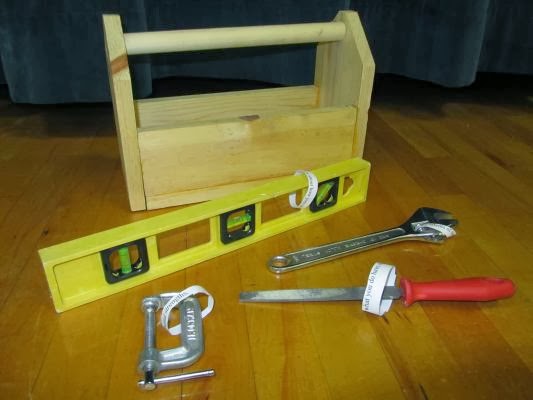
Thomas Edison once said that success is 90% perspiration. When I think of Resourcefulness I think of my grandma, who would constantly remind us to “Waste Not, Want Not.” I love the previous generations’ example of living by the philosophy of “Use it up, wear it out, make it do, or do without.” Tonight’s theme, invention convention, is about inventing, being creative, and building things. As Scout leaders it is wisdom for us to examine what is in our own toolbox of skills for creating an effective program and building boys. Maybe these tools will help you thoughtfully plan your den and pack meetings:

• Identify personal strengths.
• Use the talents of those in your group.
• Focus on what you do have, not on what you don't have.
• Think about how you can, rather than why you can't.

Cheers

Carpenter (Pretend to be holding a hammer in one hand and a nail in the other. Start pounding the nail with the hammer while saying, “Bang, bang, OUCH!”)

Light bulb (Put hands above head like a light bulb and say “Brilliant!”)

Model T (Crank with hand and make a sound like a motor turning over.)

Ben Franklin (Hold your hands like you are flying a kite. Jerk your hands while saying, “ZAP, ZAP, ZAP!”)